What is JavaScript?
It is not just 'the scripting language for websites.' That definition died around 2009. Today, JavaScript is the ubiquitous runtime of the modern digital era. Understand the history, the architecture, and the quirks that power the entire SaaS economy.
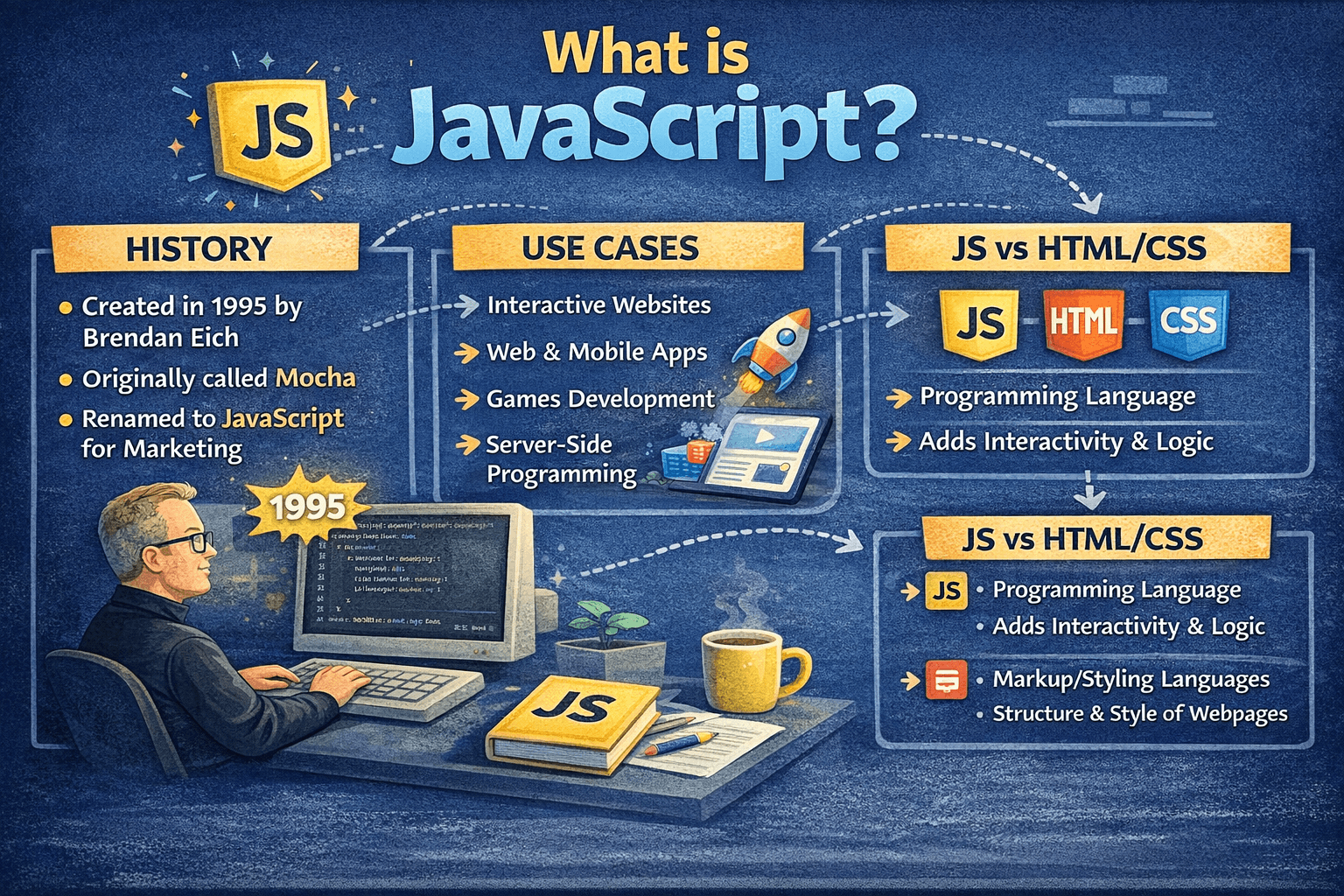
What is JavaScript?
To understand JavaScript, we must look beyond its common usage as "the language of the web" and examine how it defines itself. Because the language has evolved so drastically, a single definition is no longer sufficient.
The Definitions
1. The Standard Definition (ECMA-262, 2024/2025)
"ECMAScript is an object-oriented programming language for performing computations and manipulating computational objects within a host environment." — ECMA-262 Language Specification
Key Takeaway: JavaScript (the most popular implementation of ECMAScript) is designed to be embedded. It does not stand alone; it lives within a "host environment" like a Browser (Chrome, Firefox) or a Server (Node.js, Deno).
2. The Modern Practical Definition (MDN Web Docs)
"JavaScript (JS) is a lightweight, interpreted, or just-in-time compiled programming language with first-class functions. It is a prototype-based, multi-paradigm, single-threaded, dynamic language." — MDN Web Docs
Key Takeaway: This is how modern engineers describe it. It highlights the architectural decisions that make JS unique (and sometimes confusing).
3. The Original Definition (Netscape Press Release, Dec 4, 1995)
"JavaScript is an object scripting language... designed to create interactive web applications and web pages. [It] acts as a complement to Java." — Netscape & Sun Microsystems Joint Press Release
Key Takeaway: JavaScript was originally marketed as a lightweight "glue" language for non-programmers to use alongside the "serious" Java language. This marketing decision—naming it "Java"-Script to piggyback on Java's hype—is the source of eternal confusion.
Decoding the Definition
The modern definition contains several dense technical terms. Let's break them down.
1. High-Level
JavaScript abstracts away the hardware. You do not manage memory allocation, garbage collection, or CPU instructions. The engine handles the "metal," allowing you to focus on logic.
2. Just-In-Time (JIT) Compiled
Contrary to the popular myth that "JavaScript is an interpreted language," modern engines (like V8 in Chrome) compile JavaScript code into machine code immediately before execution. This allows it to run at speeds comparable to compiled languages like C++ or Rust for many tasks.
3. Multi-Paradigm
JavaScript does not force a single style of coding.
- Procedural: You can write simple top-to-bottom scripts.
- Object-Oriented (OOP): You can use objects and classes (though they work differently than in Java/C++).
- Functional (FP): Because functions are "first-class citizens" (they can be passed as variables), you can write pure functional code using
map,filter, andreduce.
4. Prototype-Based
This is the most misunderstood feature. In Classical OOP (Java, C++), you create a Class (blueprint) and instantiate Objects from it.
In JavaScript, there are no classes. Even the class keyword introduced in 2015 is just "syntactic sugar." Under the hood, objects inherit directly from other objects (prototypes). It is a chain of parent links, not a blueprint system.
5. Single-Threaded & Non-Blocking
JavaScript has one Call Stack. It can conceptually do only one thing at a time. However, it uses an Event Loop to handle asynchronous tasks. When you fetch data or set a timer, JS hands that task off to the browser (or Node.js) and keeps running. When the task is done, the result is pushed back onto the queue. This allows JS to handle thousands of concurrent connections without the overhead of multi-threading.
JavaScript vs. ECMAScript
- ECMAScript (ES): The Standard. It is a document (written specification) that describes how the language should work. It is like the "rules of grammar."
- JavaScript (JS): The Implementation. It is the actual language we use in browsers and servers, which conforms to the ECMAScript standard.
Think of ECMAScript as the "recipe" and JavaScript as the "cake." Other languages (like ActionScript or JScript) were also cakes baked from the ECMAScript recipe, but JavaScript is the only one that survived.
References
- ECMA International: ECMA-262 ECMAScript® 2025 Language Specification
- MDN Web Docs: About JavaScript
- Netscape Communications: Netscape and Sun announce JavaScript (Press Release, 1995)